A million lunar residents could exhaust the moon's water in a century
New research indicates that the estimated water reserves at the lunar poles are too small to support megacities for long, limiting sustainable settlement size to small towns.
By Stefan Greco ·
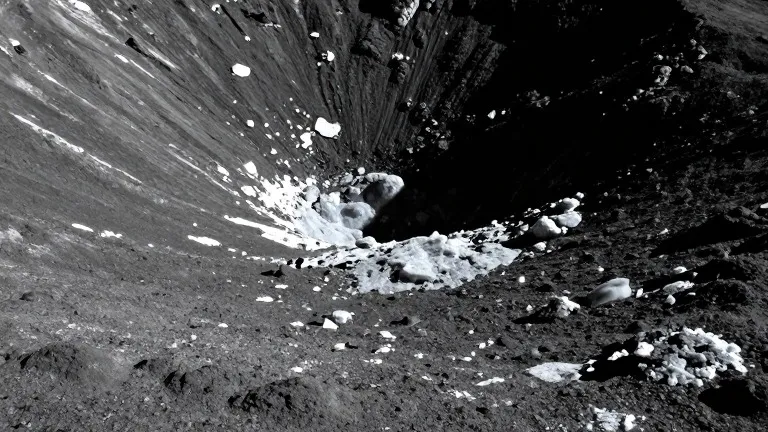
A population of one million people on the moon would deplete its known water reserves in approximately 100 years, according to a new study published in Frontiers in Space Technologies. The analysis by Martin Elvis, a senior astrophysicist at Harvard University's Smithsonian Astrophysical Observatory, and Jonathan McDowell, an honorary professor at Durham University's Space Research Centre, challenges recent assertions by tech leaders regarding the feasibility of large-scale lunar urbanization.
The researchers examined whether the lunar surface could sustain the populations envisioned by figures such as Elon Musk, who stated in February that SpaceX aims to build a self-growing city on the moon in under 10 years, and Jeff Bezos, who claimed millions would live in space by 2045. While the study found that solar and nuclear power sources are sufficient for a million-person settlement, water emerged as the primary constraint.
Most lunar water is located in permanently shadowed polar regions. The study assumes a total reserve of roughly one billion tonnes. To maintain a million-person population for a century, the settlement would need to recycle 98 percent of its water, matching the efficiency rate of the International Space Station. Elvis described the total volume as comparable to an aquarium the size of Central Park filled until the Statue of Liberty was just underwater, noting it is a small lake relative to the needs of a large city.
Smaller settlements offer greater longevity. Under the same assumptions, a town of 10,000 people could remain sustainable for centuries. McDowell stated that if humanity wants to cover the moon with cities, new methods must be developed to transport water to the surface, as the current reserves are insufficient for that scale.
The researchers acknowledge their estimates may be optimistic. Elvis suggested the actual amount of recoverable water could be 20 or 30 times smaller than the one-billion-tonne baseline. If only one percent of the estimated water is usable, the lifespan of a million-person settlement drops from 100 years to one year.
Uncertainty also exists regarding the physical state of the ice. Gordon Osinski, a planetary geology professor at Western University in London, Ontario, noted that satellite measurements contain uncertainties. He believes the water is present but could resemble Arctic permafrost, consisting of sub-millimetre ice crystals mixed into soil that are difficult to extract. McDowell emphasized that the findings clarify the limits without negating the value of attempting lunar settlement.
Source: CBC News