Harmony Module Doubles ISS Size in 2007 Shuttle Delivery
The 14-foot utility hub, built by an Italian firm, connected European and Japanese laboratories to the US segment of the International Space Station.
By Karim Graham ·
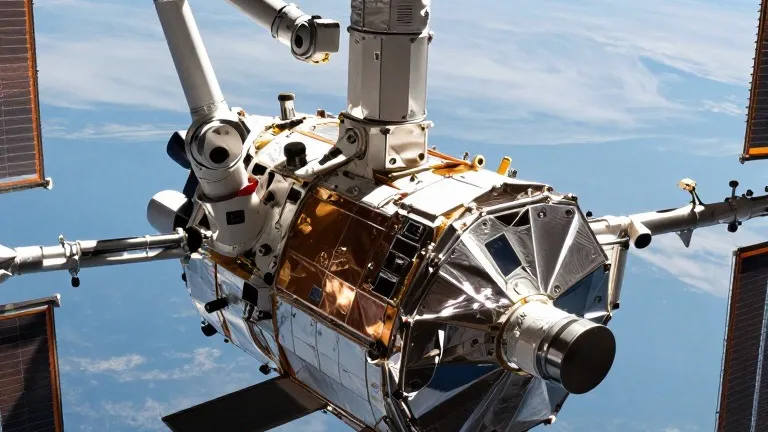
Shuttle Discovery lifted off on October 23, 2007, carrying the Harmony module to the International Space Station during the STS-120 mission.
The delivery ended a six-year gap in station construction. Before this flight, the most recent new section added to the complex was Russia's Pirs docking module, which arrived in 2001 and has since been discarded.
Harmony is a utility hub measuring 14 feet wide and 24 feet long. Its dimensions are roughly equivalent to the length of a minibus. The installation expanded the orbiting outpost from the footprint of a three-bedroom house to that of a five-bedroom house.
The module was built by Italy-based Thales Alenia Space for NASA. It was the second hub module for the station, following Unity, also known as Node 1. Harmony carries five common berthing mechanisms that serve as connection points for other segments.
Upon arrival, astronauts attached the module temporarily to the Unity node. After the shuttle departed, the crew used the station's robotic arm to move the shuttle docking port at the Destiny module. This maneuver cleared space for Harmony to be berthed at its permanent location beside Destiny.
From its final position, Harmony links the European Space Agency's Columbus laboratory on the starboard side with Japan's Kibo laboratory on the port side. Some of its ports have also hosted visiting cargo ships, while a docking port on its roof allows other vehicles to park there.
Inside, the module contains eight payload racks. Four of these are dedicated to avionics, while the other four serve as storage or crew quarters. NASA astronaut sleeping quarters are based in this space. The name Harmony was selected through a public naming contest run by NASA.
Source: Space.com