Myanmar military intensifies offensive in Rakhine State
A new military campaign has led to a surge in airstrikes against civilians in western Myanmar, with over 100,000 deaths recorded since the 2021 coup.
By Karim Graham ·
The Myanmar military launched a significant new offensive in September 2026 to retake Rakhine State, a move that has resulted in intensified aerial bombardment of civilian areas. More than five years after the military coup that overthrew the elected government, the conflict has deepened, leaving the population in the western state particularly vulnerable to attack.
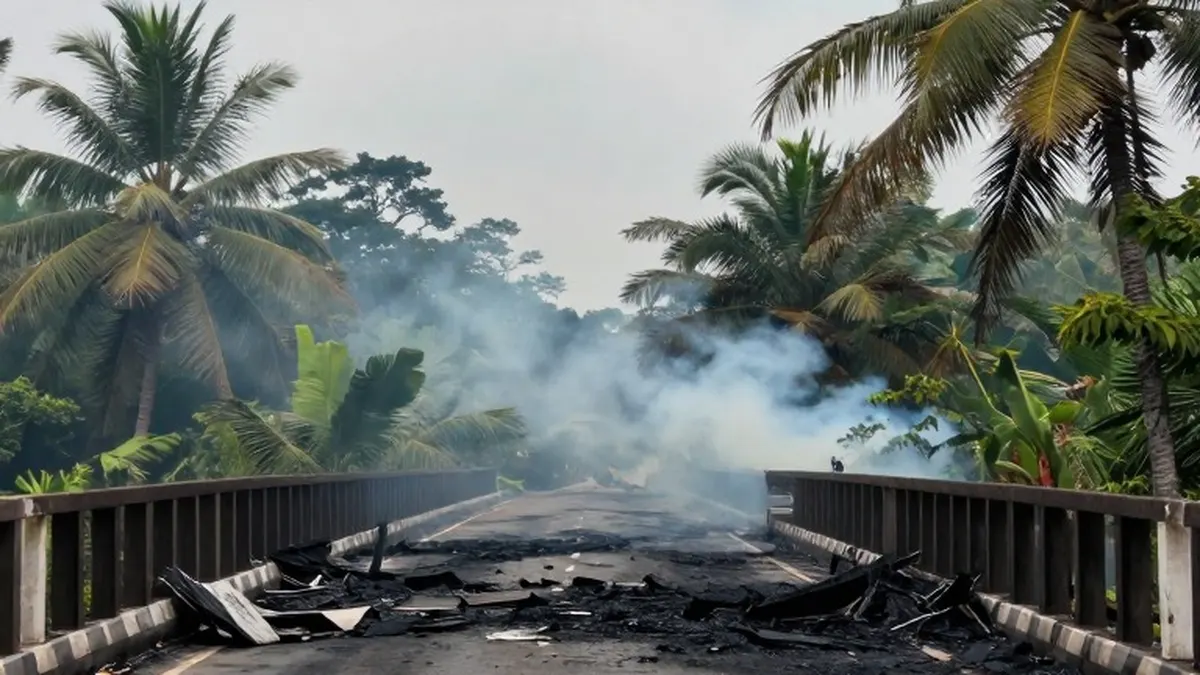
On November 1, 2026, airstrikes across Rakhine State killed 12 people and injured 32 others. Eyewitness photographs shared with the Observers editorial team depicted charred bodies and injured individuals on the Yo Chaung Bridge in Kyauktaw Township. Simultaneously, a makeshift maternity clinic in the town of Mrauk-U was struck, resulting in the deaths of five people, including a newborn, and injuries to nine others.
The offensive, designated as the Yan Naing Min campaign, began on September 4. The junta aims to reclaim the strategically important state, which is currently under the control of the Arakan Army, an ethnic armed organization, in roughly 90 percent of the region. Since the February 2021 coup, the civil war has claimed the lives of more than 100,000 people, according to data from the conflict monitoring firm ACLED.
Local humanitarian workers have described the devastation in vivid detail. Wai Hun Aung, a worker in the region, reported seeing bodies of a man and two women near the bombed clinic, with parts of the building where families stayed partially collapsed. The military has increasingly employed double-tap strikes, a tactic documented by the UN Independent Investigative Mechanism for Myanmar, which involves a second attack shortly after the first to target those rushing to aid the wounded.
Residents in Ponnagyun Township described a specific instance of this tactic on October 4. Two fighter jets made consecutive passes over a displacement camp near Thayet Cho village, dropping a standard bomb followed by an incendiary device. This attack killed six civilians and injured eleven. The following morning, the junta struck a different displacement camp, targeting areas where displaced people lived rather than specific military assets.
ACLED analyst Sun Mon noted that airstrikes have intensified since Ye Win Oo was appointed commander-in-chief of the armed forces in March 2026. He replaced Min Aung Hlaing, who led the initial coup and became president in April 2026 after a controversial election. Mon stated that the military now frequently uses multiple fighter jets and double-tap strikes against the same targets.
Data from the Myanmar Defense and Security Institute indicates that 144 civilians were killed or injured in Rakhine State during September alone. The deadliest single incident occurred on September 28, when attacks on India Market and the Kissapanadi Bridge left at least 50 people dead and 58 injured. Sun Mon observed that the junta targets any location with large gatherings, including markets, schools, hospitals, and weddings.
Volunteers have set up Telegram channels to alert residents to military aircraft takeoffs. An administrator for the Witness Enemy Air Scout channel explained that loud noises during takeoff indicate bomb loads, triggering yellow alerts, while red alerts signal active airstrikes. However, internet outages and the speed of the attacks make timely warnings difficult. On the day of the India Market attack, an alert was issued at 11:08 am, but the first report of aircraft over Kyauktaw was not published until 12:13 pm, shortly after the bombs fell.
Rakhine State holds significant strategic value for China, a key ally of the Myanmar military. China is developing transport and mining projects in the region, along with a port that provides access to the Indian Ocean. The Arakan Army, which fights for the state's independence, has intensified attacks on Kyaukphyu, a coastal town hosting these Chinese projects. While the organization enjoys local support, it has also faced accusations of abuses against the Rohingya minority.
The junta receives support from Russia and India, while the United States has resumed dialogue with the military government to contain China and access rare earth resources. Sun Mon expressed concern that the strategic interests of major powers often take precedence over the needs of the people. She noted that the international community struggles to provide meaningful support when these geopolitical goals dominate the conversation.
Source: France 24