Rocket Lab Sends Three HawkEye 360 Signals-Intelligence Satellites Into Orbit From New Zealand
An Electron rocket lifted off from New Zealand on Oct. 23 carrying three 'Hawk' satellites for Virginia-based HawkEye 360, marking Rocket Lab's 19th launch of 2026.
By News Media House Staff ·
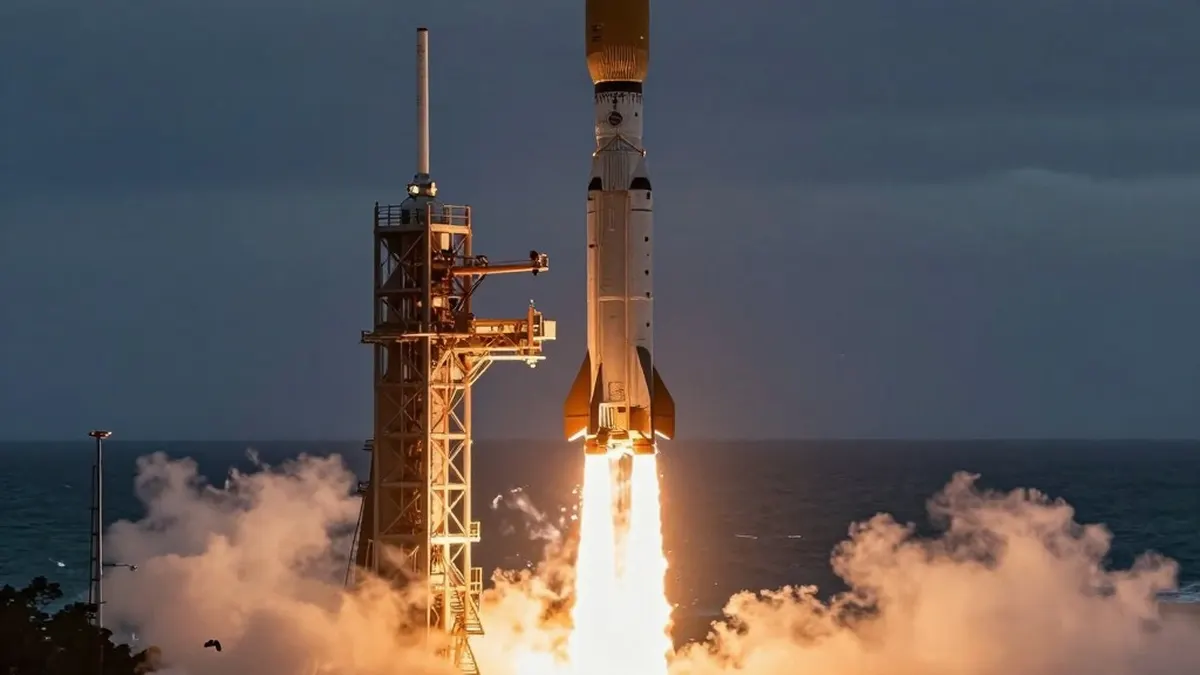
Rocket Lab launched three commercial signals-intelligence satellites into space on Oct. 23, adding another mission to a busy year for the company.
An Electron rocket lifted off from Rocket Lab's launch site in New Zealand at 3:11 a.m. EDT (0711 GMT), which was 8:11 p.m. local time. The payload consisted of three "Hawk" satellites built for HawkEye 360, a company based in Virginia. Rocket Lab named the mission "We're Not Hawking Around," a nod to the customer's satellites.
If the mission goes as planned, the three spacecraft will be released into low Earth orbit at an altitude of 323 miles (520 kilometers). After reaching that orbit and being commissioned, they will begin scanning the planet for radio frequency emissions.
Rocket Lab described the satellites' role in its mission summary. "Operating in clusters of three, HawkEye 360's satellites collect signal data from across the RF spectrum for maritime tracking, GNSS jamming detection, radar monitoring, communications mapping and space defense," the company wrote.
HawkEye 360 supplies this information to the U.S. government and its allies. The company says the aim is "to enable faster, better decision-making." It also states: "Our space-based collection, proprietary signal processing and AI-powered analytics transform knowledge of the RF spectrum into a strategic advantage."
The company's first satellites went into orbit in 2018, and it has now put nearly 50 of them into low Earth orbit. The latest launch followed another Hawk deployment by only two days: three of the satellites flew on SpaceX's Bandwagon-5 rideshare mission.
The Electron mission was Rocket Lab's 98th launch overall and its 19th of 2026. Sixteen of this year's flights have used the two-stage, 59-foot-tall (18-meter) Electron. The remaining three were flown by HASTE, a suborbital variant of Electron that lets customers test technologies in a hypersonic flight environment.
Source: Space.com