Urban Resilience: Kyiv's Shifting Dynamic Amidst Escalating Russian Aerial Assaults
The Ukrainian capital is undergoing a profound transformation as intensified strikes force millions to adapt their daily routines to the reality of constant threat.
By Stefan Greco ·
The rhythm of daily existence in the Ukrainian capital has undergone a stark transformation as enemy bombardments grow more frequent and widespread.
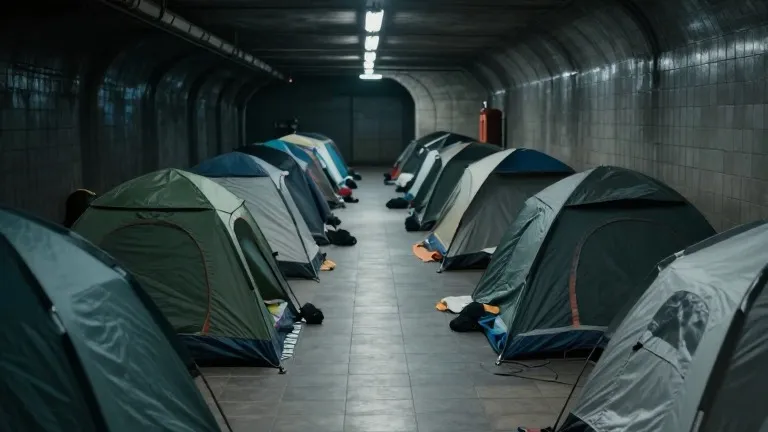
Once considered a relative sanctuary compared to the eastern front, the metropolis now mirrors the conditions of active combat zones. With the number of dedicated shelters insufficient for a population of four million, subway stations have been converted into makeshift overnight accommodations. From approximately 10 p.m. each night, residents spread out sleeping mats and erect small tents. Families and their pets settle along the cold walls, creating a temporary community underground. Halyna, a local resident, shared her perspective while holding her five-year-old son, Roman. "We're alive," she stated. "We've been lucky once again." Despite the lack of official sirens on many evenings, she brings her child to the nearest station. Her home in the Lukyanivka district has faced repeated targeting during the four years and eight months of ongoing conflict.
The human cost of these aerial attacks includes the loss of young lives. In September, a drone struck a residential building in the central Pechersk district, killing 14-year-old Daniel Umanskyj while he completed his homework. Vlad, a neighbor who was in the corridor with his daughter at the time of the impact, noted that their late arrival that day saved them. "These sick monsters don't care who they kill," he remarked. Floral tributes now mark the exterior of the damaged structure in Daniel's honor. Educational institutions have also come under fire. Early in October, a drone impacted a school in the southwestern part of the city. Fortunately, students and staff were already in shelter. Principal Valentyna Chorna explained that the institution maintains in-person classes because its large shelter can accommodate over 500 pupils from grades one through nine.
Attendance decisions hinge on shelter capacity and the duration of air raid alerts. If alarms sound while children are still at home, they may miss lessons. A correspondent's colleague, whose daughter attends a school near the Antonov aircraft factory, highlighted the burden on working parents who must leave children home alone during alerts. The journey to school itself carries risk, as warnings can be issued at any moment. Their own building was struck by a drone in September, though the apartment remained intact and the child was at school at the time.
Statistics indicate a rising casualty rate. The military administration reports that 140 individuals were killed in the capital during the first eight months of 2026, a figure exceeding the 172 deaths recorded for the entirety of 2025. If this trajectory continues, the current year could stand as the deadliest since the full-scale invasion commenced in 2022. Damage to warehouses has triggered supermarket shortages not seen since the initial phase of the war. Emergency power outages resurfaced at the end of September, and a recent attack disabled the subway system. With energy infrastructure under sustained pressure, the reliability of heat, electricity, and water supplies this winter remains uncertain.
Despite these challenges, residents demonstrate steadfast determination. A survey by the Kyiv International Institute of Sociology, released in early October, found that 72% of inhabitants in September expressed a willingness to endure the conflict for as long as required. Local authorities are working to maintain normalcy by reducing the curfew to the hours between 1 a.m. and 5 a.m. Some facilities are permitted to operate during yellow alerts, whereas red alerts, indicating potential ballistic or cruise missile threats, require immediate sheltering.
Source: Deutsche Welle