Trade Strategy: Canada and UAE Finalize Economic Pact
The deal aims to cut tariffs on 99% of Canadian exports as Ottawa diversifies away from the US market.
By Stefan Greco ·
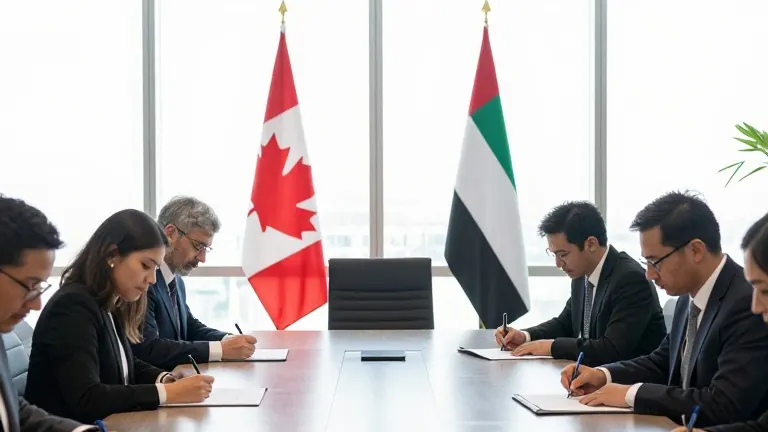
Two-way trade between Canada and the United Arab Emirates reached 3.5 billion Canadian dollars ($2.48 billion) last year. Government data indicate this figure has grown by 10 percent annually for the past few years. This existing commercial volume serves as the baseline for a new comprehensive trade agreement signed on Tuesday.
Prime Minister Mark Carney and Abu Dhabi Crown Prince Sheikh Khaled bin Mohamed bin Zayed Al Nahyan presided over the signing of the Comprehensive Economic Partnership Agreement (CEPA). The pact is designed to lower barriers between the two economies and encourage investment. It specifically targets the reduction of tariffs and the elimination of red tape to improve market access for businesses in both nations.
The agreement arrives as Carney works to widen Canada's trade ties amid ongoing tension with the United States. After tariffs imposed by US President Donald Trump rippled through the Canadian economy, Carney pledged to double Ottawa's non-US trade over the next decade. Subsequent attempts to reach a deal with Washington broke down, pushing the Canadian government to pursue trade pacts with countries from the Asia Pacific to Europe and the Middle East.
The Prime Minister's Office stated that once fully implemented, CEPA will reduce or eliminate tariffs on more than 99 percent of current Canadian exports to the UAE. This change would open new markets for farmers growing pulses and canola. It also benefits manufacturers of industrial machinery and power generation equipment, as well as the aerospace sector. The office noted that the deal will tackle non-tariff barriers and expand access for goods and services in the industrial, agricultural, forest, fish, seafood, environmental, and engineering sectors. CEPA is expected to enter into force in 2027.
Alongside the main trade pact, the two countries signed preliminary agreements on energy, diplomatic, and defense cooperation. Maninder Sidhu, Canada's foreign trade minister, signed the deal with his UAE counterpart, Thani bin Ahmed Al Zeyoudi. Al Zeyoudi said the agreement holds considerable potential for the private sector. He pointed to improved market access for exporters and investment opportunities in high-growth areas such as logistics, communications, advanced technology, and manufacturing.
Al Zeyoudi stated these sectors would support a resilient, diversified, and globally connected economy. The UAE is already the largest Middle East market for Canadian exports. It is a major buyer of Canadian motor vehicles, parts, and machinery. Last year, the UAE also committed up to $50 billion in investment in Canada.
Source: Al Jazeera
More Business · World news · Watch Your Wallet · Report a business · Got a Story?